Is ‘Haunter’ a Horror Classic? Expert Review
Haunter (2013), directed by Vincenzo Natali, occupies a peculiar position in contemporary horror cinema. This Canadian supernatural thriller presents a genuinely innovative premise—a teenage girl trapped in a time loop, forced to relive the same day while being hunted by a malevolent entity—yet remains largely underappreciated in broader horror discourse. While the film doesn’t achieve the cultural penetration of certified classics, it demonstrates remarkable craftsmanship, thematic depth, and the kind of imaginative world-building that ScreenVibeDaily explores when analyzing emerging genre standards.
The central question of whether Haunter deserves classic status requires examining not just its technical execution, but its influence on horror storytelling, its narrative innovation, and how it functions within the broader ecosystem of supernatural cinema. This review dissects these elements comprehensively, offering both critical analysis and contextual positioning within horror’s evolving landscape.
Plot Synopsis and Premise Innovation
Haunter follows Abigail “Lisa” Brenner, a teenager who awakens to discover she’s trapped in a purgatorial existence, reliving the same day repeatedly. Unlike typical time-loop narratives focused on comedic repetition or self-improvement arcs, Haunter establishes genuine dread through the revelation that Lisa’s family isn’t real—they’re manifestations, and something predatory lurks at the periphery of her reality. The film’s central innovation lies in weaponizing the time-loop concept as a horror mechanism rather than a comedic or philosophical device.
This distinction matters significantly when discussing horror classics. The film’s premise doesn’t merely borrow from established tropes; it synthesizes temporal mechanics with supernatural terror in ways that feel genuinely original. Lisa’s growing awareness that she’s dead, that her family is constructed illusion, and that an ancient entity feeds on teenage girls across decades creates escalating psychological horror that transcends jump-scares or gore-based intimidation. The narrative structure rewards repeated viewing, as viewers catch foreshadowing details and realize the film’s careful construction of its own mythology.
The time-loop framework also serves thematic purposes beyond plot mechanics. Each repetition represents Lisa’s journey toward acceptance, understanding, and ultimately defiance. This integration of formal structure with thematic meaning represents the kind of sophisticated storytelling that defines critically acclaimed horror analysis.
Directorial Vision and Technical Execution
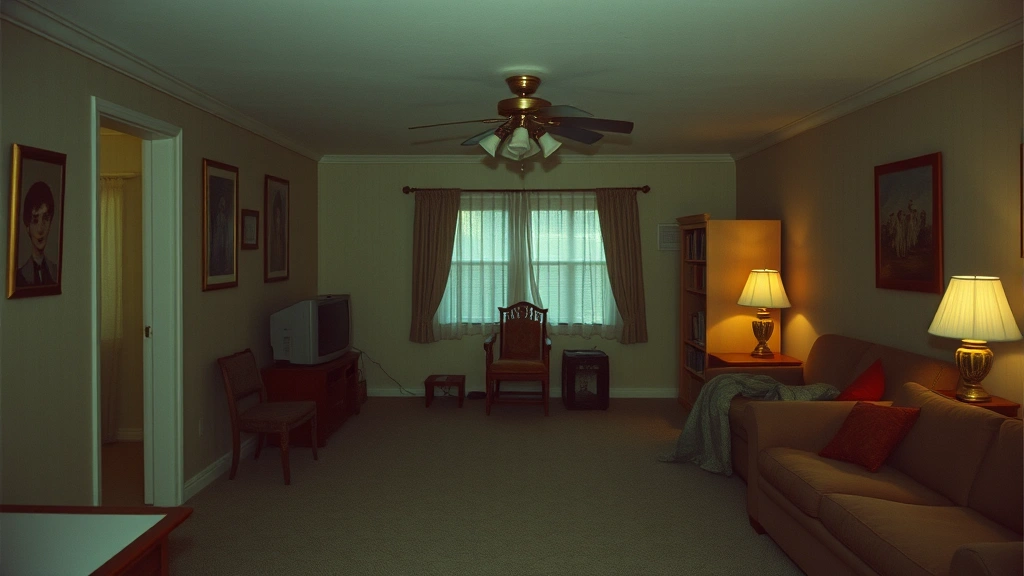
Vincenzo Natali’s directorial approach demonstrates remarkable visual discipline and atmospheric control. His background in science fiction and body-horror cinema (evident in films like Cube and Splice) informs Haunter‘s aesthetic choices. The film employs subdued color grading, emphasizing drab greens and sickly yellows that create pervasive unease without relying on darkness or oversaturation. This technical choice proves crucial—the horror emerges from the mundane rendered subtly wrong, rather than from theatrical presentation.
Natali’s use of camera movement deserves particular attention. Static shots dominate early sequences, establishing Lisa’s trapped existence through compositional stasis. As her awareness grows, the camera becomes increasingly mobile, mirrors distort, and perspectives shift. This visual language communicates psychological transformation without exposition, demonstrating filmmaking sophistication often absent from contemporary horror productions. The technical execution avoids the found-footage gimmickry or shaky-cam aesthetic that plagued horror cinema during the 2010s.
The production design contributes significantly to the film’s success. The Brenner house functions as a character itself—familiar yet uncanny, comfortable yet suffocating. The costume design similarly walks a careful line, featuring clothing styles that seem slightly off-temporal, neither fully period-accurate nor contemporary. These details accumulate to create cognitive dissonance, preparing audiences for the film’s revelations about reality’s constructed nature.

Thematic Complexity and Psychological Depth
Beyond its surface narrative, Haunter engages with sophisticated thematic material. The film explores grief, acceptance, and the psychological mechanisms by which we deny uncomfortable truths. Lisa’s initial resistance to acknowledging her situation mirrors how we collectively process trauma—through denial, rationalization, and constructed normalcy. The film suggests that acceptance and agency require confronting painful reality, a thematic trajectory with genuine emotional resonance.
The film also interrogates female vulnerability and predatory violence. The supernatural threat specifically targets teenage girls, positioning them as prey within a system (purgatory itself) that permits their exploitation. Yet Haunter resists victimization narratives; Lisa’s agency grows as her understanding deepens. She moves from passive acceptance to active resistance, ultimately becoming a threat to the predator rather than remaining a victim. This narrative arc carries feminist implications that elevate the film beyond standard supernatural horror.
Additionally, the film explores identity and selfhood. If Lisa’s family is constructed illusion, what aspects of Lisa are real? What constitutes authentic identity when consciousness itself may be fabrication? These philosophical questions align Haunter with cerebral horror traditions, positioning it alongside films that prioritize psychological complexity over visceral shock. The film’s willingness to engage these questions without providing definitive answers demonstrates thematic maturity.
Performance Analysis and Character Development
Abigail Breslin’s central performance anchors the entire film. Her portrayal of Lisa captures the subtle emotional transitions required for the narrative to function—from comfortable teenage normalcy through growing unease to determined agency. Breslin avoids melodrama or excessive expressionism, instead conveying psychological transformation through micro-expressions and physical comportment. Her performance communicates Lisa’s internal state without relying on dialogue exposition, demonstrating mature acting technique.
The supporting cast, particularly Michelle Nolden and David Morse as Lisa’s parents, creates the uncanny family dynamic essential to the film’s effectiveness. Their performances walk a precise line—seeming genuinely loving while carrying subtle wrongness that viewers only recognize retrospectively. This requires tremendous control; too much oddity reveals the twist prematurely, while too much normalcy undermines the growing dread. The ensemble achieves this balance admirably.
Peter Outerbridge deserves mention for his portrayal of the film’s central antagonist. His performance conveys predatory intelligence without resorting to theatrical villainy. The creature’s disguise as a friendly neighborhood visitor demonstrates how the film uses performance itself as a horror mechanism—the audience’s discomfort stems partly from recognizing danger that appears socially acceptable.
Comparative Analysis Within Horror Canon
Assessing whether Haunter qualifies as a “horror classic” requires comparing it to established touchstones. The film shares DNA with acknowledged classics: The Sixth Sense‘s twist revelation, Poltergeist‘s haunted-house mythology, Groundhog Day‘s repetition mechanics. Yet Haunter synthesizes these influences into something distinct. It doesn’t merely borrow; it integrates, creating a unique synthesis that feels both familiar and original.
Compared to contemporary horror (2010-2013 era), Haunter stands apart through its emphasis on atmosphere and psychological complexity over jump-scares or gore. During a period dominated by found-footage horror and torture-porn aesthetics, Haunter maintained classical storytelling discipline. This positioning—respecting audience intelligence while avoiding pretension—characterizes truly enduring horror cinema.
The film’s relationship to available horror on streaming platforms reveals its quality differential. Among thousands of horror titles, Haunter demonstrates technical proficiency and creative ambition that distinguishes it from derivative productions. Its presence on major platforms hasn’t translated to widespread cultural recognition, suggesting that classic status depends on factors beyond mere availability.
Influence and Legacy Assessment
A crucial factor in determining classic status involves assessing influence on subsequent works. Has Haunter influenced horror filmmaking? The evidence suggests modest but meaningful impact. The film’s sophisticated approach to time-loop horror appears in subsequent productions, while its integration of supernatural mythology with psychological complexity influenced indie horror makers prioritizing narrative innovation over budget spectacle.
The film’s existence on streaming services has extended its reach beyond theatrical audiences, creating ongoing discovery patterns. This delayed recognition mirrors how various horror classics achieved canonical status posthumously, through home video distribution and critical reassessment. Haunter may benefit from similar trajectory, as critics and filmmakers increasingly recognize its contributions to horror’s formal and thematic development.
However, genuine classic status requires more than influence—it demands cultural persistence and critical consensus. Haunter hasn’t achieved the universal recognition of The Shining, The Exorcist, or Psycho. Whether it eventually reaches that tier depends on sustained critical attention, continued discovery by new audiences, and its demonstrated capacity to reward repeated viewing across decades. Current evidence suggests Haunter occupies the “cult classic” category—deeply appreciated by devoted audiences, respected by critics, but not yet universally recognized.
Critical Reception and Audience Response
Professional critics received Haunter positively, with particular praise for its originality and technical execution. Reviews highlighted Natali’s directorial control, Breslin’s performance, and the film’s ambitious narrative structure. However, critical appreciation didn’t translate to mainstream cultural penetration. The film’s theatrical release was limited, and its subsequent streaming availability, while expanding viewership, didn’t generate the cultural conversation accompanying major horror releases.
Audience responses, tracked through various platforms, reveal enthusiastic appreciation among those who discover the film. User ratings on major platforms consistently exceed 7/10, with many viewers expressing surprise at the film’s quality and originality. This pattern—strong appreciation among viewers who engage with it, but limited awareness among general audiences—characterizes many films that eventually achieve cult classic status.
The film’s reception also reflects broader patterns in horror appreciation. Audiences increasingly value originality, thematic depth, and technical proficiency over franchise recognition or celebrity casting. Haunter aligns with these emerging values, suggesting its critical standing may improve as horror discourse continues evolving. Understanding these patterns requires consulting contemporary research on media consumption and genre appreciation.
When examining whether Haunter deserves classic recognition, we must also consider how film criticism itself approaches evaluation. Modern critical frameworks increasingly value diversity of voices, representation considerations, and thematic sophistication. Haunter performs well under these contemporary standards, featuring a strong female protagonist in an active rather than passive role, exploring themes relevant to modern audiences, and demonstrating technical proficiency that rewards critical analysis.
The film’s position within horror streaming ecosystems also matters. Unlike theatrical releases, streaming films compete for attention within overwhelming catalogs. Haunter‘s continued presence on major platforms, combined with algorithmic recommendations and critical recognition, ensures ongoing discovery. This differs fundamentally from theatrical-era classics, which achieved recognition through limited but concentrated exhibition. Understanding these distribution differences proves essential for contextualizing Haunter‘s legacy.
International reception patterns also reveal interesting data. Haunter achieved stronger recognition in certain markets, particularly Canada and Europe, where critical appreciation for innovative horror tends toward greater prominence. This geographic variation suggests that classic status isn’t universal but rather culturally contingent—films may achieve canonical recognition within specific critical or geographic communities before achieving broader acknowledgment.
Verdict: Classic Status Assessment
Rendering a final verdict requires distinguishing between potential and current status. Haunter possesses the technical proficiency, narrative innovation, thematic depth, and performance quality that characterize genuine horror classics. Its sophisticated approach to time-loop mechanics, atmospheric tension, and psychological complexity demonstrates filmmaking that transcends generic conventions. The film rewards repeated viewing, revealing layers of foreshadowing and thematic resonance that improve with familiarity—a hallmark of enduring cinema.
However, true classic status requires more than individual excellence; it demands cultural penetration, critical consensus, and demonstrated influence across decades. Haunter currently occupies an intermediate position—a film of undeniable quality and originality that hasn’t yet achieved universal recognition. This positioning isn’t unusual; many films eventually recognized as classics initially received limited theatrical distribution and gradual audience discovery.
The most accurate assessment positions Haunter as a “proto-classic”—a film with all the characteristics necessary for eventual canonical inclusion, awaiting broader critical and cultural recognition. For viewers seeking sophisticated horror entertainment, the film represents contemporary cinema at its finest. For horror historians assessing the genre’s evolution, Haunter documents important developments in how contemporary filmmakers approach supernatural storytelling.
Ultimately, Haunter deserves recognition not as a confirmed classic but as a candidate for eventual canonical status—a film that meets the technical and artistic standards that define horror excellence, awaiting the cultural consensus that transforms quality into timelessness. Viewers encountering Haunter for the first time should approach it as serious cinema, not guilty-pleasure entertainment, and expect the kind of thematic and narrative sophistication that rewards patient engagement and critical attention.
FAQ
What is the Haunter movie about?
Haunter follows a teenage girl who discovers she’s trapped in a time loop, reliving the same day while discovering her family isn’t real and a predatory entity hunts her. The film combines supernatural horror with psychological complexity as she works toward understanding and escaping her purgatorial existence.
Who directed Haunter?
Vincenzo Natali directed Haunter (2013). Natali, known for science fiction and body-horror films like Cube and Splice, brought his distinctive visual style and thematic sophistication to this supernatural thriller.
Is Haunter appropriate for younger audiences?
Haunter received a PG-13 rating, though it contains thematic elements involving death and some frightening imagery. Younger viewers sensitive to psychological horror or existential themes might find it unsettling, though it avoids graphic violence or gore.
How does Haunter compare to other horror films?
Haunter distinguishes itself through sophisticated integration of time-loop mechanics with psychological horror, strong character development, and atmospheric tension over jump-scares. It shares thematic elements with acclaimed films like The Sixth Sense while maintaining its own distinct identity.
Where can I watch Haunter?
Haunter is available on various streaming platforms, including Netflix and other services depending on your region. For current availability, check streaming guides and platform catalogs.
Why isn’t Haunter more famous?
Haunter received limited theatrical distribution and faced competition from higher-budget horror productions. Its gradual discovery through streaming platforms and critical reassessment suggests it may eventually achieve greater recognition, following patterns of how other quality films achieve canonical status.
What makes Haunter a quality horror film?
The film excels through directorial control, innovative narrative structure, strong performances, thematic depth, and technical proficiency. It prioritizes psychological complexity and atmospheric tension over gore or cheap scares, demonstrating filmmaking sophistication that rewards critical analysis.
Is Haunter considered a classic?
Haunter possesses the qualities that define horror classics but hasn’t yet achieved universal critical consensus or cultural penetration necessary for confirmed canonical status. It represents a “proto-classic”—a film likely to gain greater recognition over time as critical appreciation evolves and audiences discover its merits through expanded access.