Stop Making Sense: A Timeless Concert Film Review
David Byrne’s Stop Making Sense remains one of cinema’s most innovative and influential concert films, transcending the limitations of live music documentation to become a standalone artistic statement. Released in 1984 and directed by Jonathan Demme, this film captures Talking Heads at their creative peak, transforming a stage performance into a visual and sonic experience that continues to captivate audiences four decades later. The film’s groundbreaking approach to concert cinematography, its meticulous production design, and Byrne’s distinctive artistic vision have secured its place as essential viewing for anyone interested in music, film, and contemporary performance art.
What makes Stop Making Sense particularly remarkable is its refusal to be merely a documentation of events. Instead, Demme and Byrne constructed a narrative arc that builds from intimate simplicity to elaborate theatrical spectacle, creating an emotional and intellectual journey that mirrors the band’s own creative evolution. The film begins with Byrne alone on a bare stage with an acoustic guitar and ends with the entire ensemble performing in full costume and makeup, supported by an intricate set design and lighting rig. This progression isn’t arbitrary—it’s carefully orchestrated to explore themes of creation, performance, anxiety, and transcendence that resonate far beyond the concert hall.
The Revolutionary Approach to Concert Cinema
Before Stop Making Sense, concert films operated within predictable parameters. They typically featured a stationary camera recording a band performing their greatest hits in sequence, often with minimal editing and straightforward documentation aesthetics. This film shattered those conventions entirely. Jonathan Demme’s direction introduced cinematic language to concert performance, employing close-ups, wide shots, creative angles, and dynamic editing techniques that transform the viewing experience from passive observation to active engagement.
The film’s structural innovation lies in its rejection of traditional setlist documentation. Instead of presenting songs in the order they were performed, Demme and Byrne curated a specific sequence designed to create narrative momentum and emotional resonance. The opening sequence—featuring Byrne alone with his guitar performing “Psycho Killer”—establishes an intimate connection between performer and audience that makes subsequent additions feel like natural expansions rather than mere technical augmentations. This approach influenced countless concert films that followed, establishing new standards for how live music could be presented cinematically.
The film also pioneered the use of multi-camera coverage in concert settings. Rather than relying on a single camera position, Demme deployed multiple cameras capturing the performance from various angles simultaneously. This allowed for sophisticated editing that maintains visual interest without relying on confusing cuts or distracting transitions. The result feels both immediate and carefully crafted, capturing the spontaneity of live performance while maintaining cinematic polish.
Visual Direction and Cinematographic Innovation
Jonathan Demme’s directorial vision represents a masterclass in visual storytelling. His background in narrative filmmaking informed every compositional choice, from camera placement to lighting design to editorial decisions. The cinematography by Jordan Cronenweth creates a visual language that complements Talking Heads’ aesthetic while establishing its own distinct identity. The film employs a predominantly neutral color palette with strategic use of primary colors and stark lighting that echoes the band’s post-punk sensibilities.
One of the most striking visual elements is Demme’s use of the human face as a compositional anchor. Close-ups of Byrne’s expressive features, drummer Chris Frantz’s concentrated focus, bassist Tina Weymouth’s subtle movements, and keyboardist Jerry Harrison’s technical precision create intimate moments within the larger concert spectacle. These moments humanize the performers, reminding viewers that beneath the theatrical presentation lies genuine musical communication and emotional investment.
The film’s treatment of space deserves particular attention. The Rose Bowl venue serves as more than just a location—it becomes a character itself. The cavernous architecture, the subtle variations in lighting across different areas of the stage, and the relationship between performers and the vast audience all contribute to the film’s visual narrative. Demme’s camera moves through this space with purpose, sometimes pulling back to show the ensemble’s spatial relationships and sometimes isolating individual performers to emphasize their contributions.
For those interested in understanding how films are constructed, our guide on how to produce a short film offers practical insights into the technical aspects of filmmaking that Demme employs here.

Performance Art and Theatrical Design
David Byrne’s performance style in Stop Making Sense transcends traditional rock concert presentation. His movements range from precise, jerky choreography to spontaneous physical expression, creating a visual language that complements the music’s intellectual and emotional content. The oversized suit he wears in later sections—designed by Adelle Lutz—becomes iconic, visually representing the tension between individual identity and social conformity that permeates Talking Heads’ lyrical content.
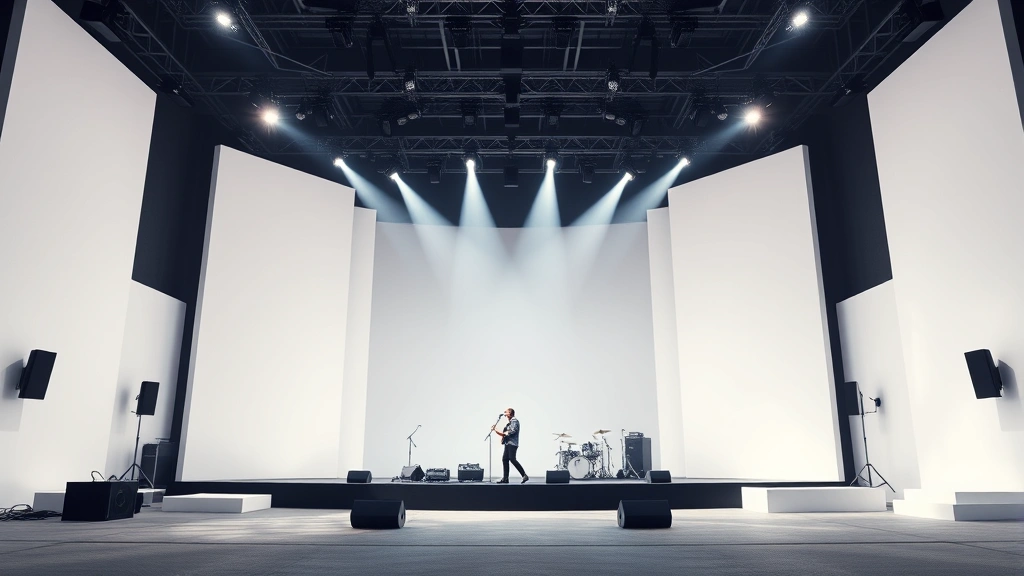
The theatrical design extends beyond costume into the entire visual environment. As the film progresses, the stage transforms from bare minimalism to elaborate architectural structures. Curved white frames, geometric shapes, and carefully positioned lighting elements create a stage design that feels both futuristic and organic. This evolution mirrors the musical progression, with simple compositions expanding into complex arrangements supported by visual complexity.
The band members’ positioning on stage follows deliberate choreography. Rather than standing in traditional rock band formation, the ensemble constantly shifts and repositions itself. Musicians move between stations, creating dynamic spatial relationships that keep the visual composition fresh and engaging. This approach emphasizes the collaborative nature of the music while maintaining visual interest throughout the performance.
Byrne’s interactions with his band members reveal genuine musical communication and respect. The subtle nods, the synchronized movements, and the moments of musical call-and-response all suggest a deep artistic partnership. This authenticity distinguishes Stop Making Sense from concert films that feel like documentation of predetermined performances. Instead, this feels like witnessing creative collaboration in real time, even though the film was carefully constructed during post-production.
Musical Composition and Song Selection
The setlist for Stop Making Sense represents a carefully curated selection of Talking Heads material spanning their career to that point. The song choices reflect both commercial appeal and artistic depth, introducing casual viewers to the band’s intellectual approach to rock music while satisfying longtime fans. Opening with “Psycho Killer” immediately establishes the band’s signature style—minimalist arrangements, anxious vocals, and lyrics exploring psychological and social themes.
The progression through songs like “Heaven,” “Thank You for Sending Me an Angel,” and “Cities” builds musical momentum while maintaining intellectual engagement. Each song receives distinctive treatment within the film, with Demme’s direction emphasizing different aspects of the band’s sound. Some songs feature minimal visual accompaniment, allowing the music to dominate, while others incorporate elaborate staging and choreography.
The film’s penultimate sequence—”Once in a Lifetime”—represents perhaps the most ambitious musical and visual statement. The song’s hypnotic groove, Byrne’s distinctive vocal delivery, and the ensemble’s synchronized movements create a moment of transcendence that feels both intellectually satisfying and emotionally overwhelming. The song’s philosophical lyrics about existence and meaning take on additional resonance when presented with such visual and sonic power.
The closing number, “Life During Wartime,” provides a fitting conclusion that returns to the band’s political consciousness and social commentary. The performance captures the energy and urgency that defined Talking Heads’ artistic mission, leaving audiences with a sense of purpose and engagement rather than mere entertainment satisfaction.
If you’re interested in exploring more about how artistic vision translates across different media, check out our collection of top famous movie quotes that capture similar thematic resonance.
Cultural Impact and Legacy
Upon its release, Stop Making Sense received critical acclaim and achieved unusual commercial success for a concert film. The film earned recognition as a significant artistic achievement, influencing not only how concert films were subsequently made but also how musicians approached live performance documentation. The film demonstrated that concert films could be legitimate artistic statements worthy of serious critical consideration, not merely supplementary materials for music fans.
The film’s influence extends beyond concert cinema into broader filmmaking practices. Demme’s innovative editing techniques, his use of close-ups to create emotional connection, and his understanding of how music and image could work together informed his subsequent narrative films, including Silence of the Lambs and Philadelphia. The lessons learned during Stop Making Sense production became foundational to his entire directorial approach.
For musicians, the film established new possibilities for live performance presentation. Artists recognized that concert films could explore themes beyond simple documentation, using visual language to enhance and expand musical meaning. This influenced how contemporary artists approach concert films and live performance streaming, with many now considering the visual presentation as integral to the artistic statement as the music itself.
The film also contributed to Talking Heads’ legacy as one of the most important rock bands of their era. While the group had achieved significant success before the film’s release, Stop Making Sense solidified their cultural importance and introduced their music to audiences who might not have encountered them otherwise. The film’s continued relevance demonstrates the band’s enduring artistic significance.
For comprehensive analysis of how films achieve critical recognition, our best movie review sites guide provides context for understanding critical discourse.
Technical Mastery and Production Quality
The technical execution of Stop Making Sense represents professional filmmaking at the highest level. The cinematography, lighting design, sound mixing, and editing all work in seamless coordination to create a cohesive artistic experience. Jordan Cronenweth’s cinematography employs sophisticated color grading and composition that elevates the material beyond typical concert documentation.
The sound design deserves particular recognition. Rather than simply recording the live performance, the filmmakers employed multi-track recording techniques that allowed for post-production mixing and enhancement. This approach maintains the spontaneity and energy of live performance while ensuring optimal audio clarity and balance. The film’s soundtrack, released separately as both audio and video, became a significant commercial success in its own right.
The editing, overseen by Craig McKay, demonstrates remarkable sophistication in maintaining visual and rhythmic coherence. The cuts synchronize with musical beats and lyrical emphases, creating a symbiotic relationship between image and sound. This technical precision never feels mechanical or artificial—instead, it enhances the emotional and intellectual impact of the performances.
The lighting design works in concert with the stage design and cinematography to create visual interest and emotional resonance. As the performance progresses and the stage becomes more elaborate, the lighting becomes more sophisticated, with multiple light sources creating depth and dimension. The interplay between performers, stage elements, and lighting creates a three-dimensional visual space that feels both theatrical and cinematic.
For those interested in exploring more concert films and performance documentaries, our 123 movies free streaming guide includes various performance-based cinema options worth exploring.

FAQ
When was Stop Making Sense released?
Stop Making Sense premiered on October 19, 1984, at the New York Film Festival before receiving wider theatrical release. The film was shot during three performances at the Hollywood Rose Bowl in December 1983.
How did Jonathan Demme approach directing a concert film?
Demme applied narrative filmmaking techniques to concert documentation, employing multiple cameras, sophisticated editing, and compositional strategies typically reserved for fictional narratives. He worked closely with David Byrne to structure the performance as a complete artistic statement rather than simple documentation.
What makes the film’s visual progression significant?
The film begins with David Byrne alone on a bare stage and progressively adds band members, elaborate staging, and theatrical elements. This architectural progression creates emotional and intellectual momentum, mirroring themes of creation, growth, and transcendence explored in the band’s music.
Has Stop Making Sense influenced other concert films?
Yes, significantly. The film established new standards for concert cinema, demonstrating that live music could be presented with sophisticated cinematic language. Subsequent concert films have adopted similar approaches to editing, composition, and narrative structure.
Where can audiences watch Stop Making Sense today?
The film remains available through multiple distribution channels, including theatrical re-releases, home video formats, and streaming services. A restored 4K restoration was released in 2021, introducing the film to new audiences with enhanced visual quality. You might explore options through our ScreenVibe Daily Blog for current viewing information.
What is the film’s cultural significance beyond music?
Beyond its impact on concert cinema and music documentation, Stop Making Sense represents an important moment in 1980s artistic expression. The film captures a specific cultural moment while exploring universal themes of performance, identity, and artistic collaboration that remain relevant to contemporary audiences.


